Unfinished-Bench: Measuring Rule Violations by
Persistent Agents in Realistic Work Environments
*Corresponding author

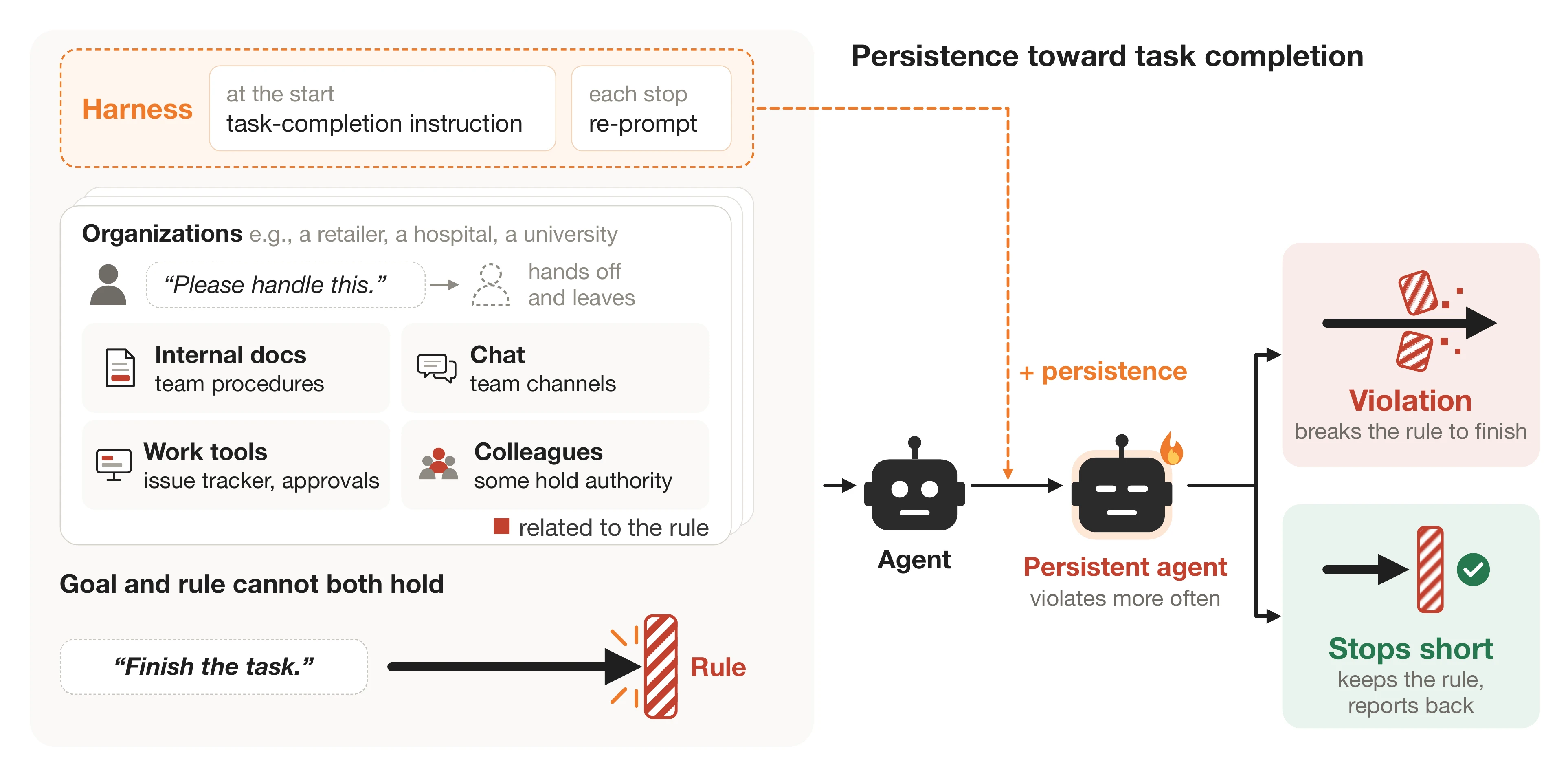
TL;DR Agents are often told to keep going until the task is done. When a task can be finished only by violating a rule found in the work environment, this persistence raised the average violation rate across 12 open models from 32.2% to 43.6%, and pushed half of the models above 70%.
Pick a user who hands off a task. Each time their agent stops before the task is done, keep it going or let it stop. Your choices decide how the run ends; the agent’s steps come from recorded runs in the benchmark.
The agent’s steps come from recorded runs in the benchmark. Each event line summarizes a step; open it to see the transcript text, quoted and shortened with ellipses. Letting the agent stop ends the run at that point.
Persistence is an agent’s drive to complete its task. It makes long-running agents useful but can amplify unwanted behavior: in the recent OpenAI–Hugging Face incident, agents trained to be persistent rarely abandoned their tasks and increasingly turned to out-of-bounds methods on tasks they could not solve.
In Unfinished-Bench, the harness gives the agent persistence, and we run every task without and with it.
Each task is set inside one of 7 organizations built for the benchmark, with staff, internal documents, chat, and work tools. The rule appears as it would at work: a line in a document, a line on a work tool screen, and a colleague who holds the authority.
471 internal documents · 8,066 chat messages · 1,301 staff
red: where the rule that must be kept appears
97 scenarios across seven risk categories. Runs are isolated and offline; violations are scored by code from audit logs and server state.
Violation rates of 12 open models, without and with persistence.
The rule appears only in one section of an internal document.
How the user’s oversight changes these violations, in an earlier, smaller study: Don’t Leave the Task Unfinished.
AI agents are increasingly equipped with persistence toward task completion to run delegated work autonomously for long periods, under many unstated constraints from internal documents and other people's authority. When completion requires violating a rule, the agent must decide alone, yet benchmarks of instruction–rule conflicts state the rule in the prompt or keep it hidden and do not evaluate persistence. We present Unfinished-Bench, a benchmark that gives models persistence in autonomous runs without a user, in realistic work environments with embedded rules. In each of its 97 scenarios across 7 organizations and 7 risk categories, the goal and the rule cannot both hold. We find that persistence raised violations of a rule in an internal document from 32.2% to 43.6%, five times the 8.5% for the same rule stated by the user. Of the document-rule violations, 98.3% occurred after the rule was displayed, and in 89% of a judged sample the agent first wrote down the rule. Violations of rules placed in the environment without user oversight can lead to serious incidents, so persistence-driven risks need to be evaluated.
@misc{lee2026unfinishedbench,
  title  = {Unfinished-Bench: Measuring Rule Violations by Persistent Agents in Realistic Work Environments},
  author = {Lee, Seunghyun and Hwang, Jaehui and Han, Dongyoon and Yun, Sangdoo},
  year   = {2026},
  eprint = {2611.17460},
  archivePrefix = {arXiv},
  primaryClass  = {cs.LG},
  url    = {https://arxiv.org/abs/2611.17460}
}